CodeToCashAI / Automated futures infrastructure
Rules working after you stop watching.
CodeToCashAI converts a defined futures-trading process into software that can monitor conditions, enforce configured risk limits, and execute without constant chart watching. This brief shows what the system is, what the current evidence means, and where human control remains.
02 / Evidence
Performance should be inspected, not admired.
Returns without drawdown, trade count, period, assumptions, and execution context are incomplete. CodeToCashAI separates historical tests from live outcomes and keeps the difficult periods visible.
Normalized equity preview
+400%
Selected 12-month historical test
StartQ1Q2Q3Q4End
Historical backtests are hypothetical and have inherent limitations. They do not account perfectly for every live-market condition, including slippage, commissions, liquidity, connectivity, contract selection, or future regime changes. The equity curve above is an illustrative normalized reconstruction of the supplied summary, not an independently audited live account.
03 / Operating model
The system follows conditions. It does not chase predictions.
Each stage has a specific responsibility. Software supplies consistency and speed; the user still decides the account, capital, configuration, and whether the system should be active.
Monitor
The software watches defined market sessions and waits for the exact conditions encoded in the strategy.
Validate
Before an order is permitted, the setup is checked against the configured session, position, and risk rules.
Execute
The connected platform routes and manages the permitted order according to the predefined trade plan.
Layer 01
Rules Engine
A repeatable strategy definition specifies the market conditions required before a setup exists. When those conditions are absent, the correct action is no trade.
DefinedConditions
FixedProcess
SessionAware
TestableLogic
04 / Safety and custody
Your account. Your connection. Your decision.
The intended model does not require pooling trading capital with CodeToCashAI. Compatibility and exact permissions depend on the selected broker, platform, account type, and region.
You select the account
Your brokerage or supported provider holds the account under its own terms. You retain the credentials and funding decisions.
The system sends instructions
The strategy monitors, validates, and routes permitted trade instructions through the supported connection.
You retain control
You can review activity, change supported configuration, pause the system, or disconnect the integration.
TradingViewMetaTrader 5TradovateNinjaTraderAMP FuturesInteractive Brokers
Compatibility is evaluated case by case. The appearance of a platform or broker name does not imply endorsement or universal support for every account, product, region, or configuration.
05 / Alternatives
A system is useful when it changes the operating burden.
The comparison is about process, not promises. Automated execution can reduce decision fatigue while preserving the need for supervision, risk limits, and realistic expectations.
| Operating question | Manual trading | Opaque bot | CodeToCashAI model |
|---|---|---|---|
| Daily chart attention | Often required | Varies | Exception-based review |
| Rules visible before entry | Depends on discipline | Often unclear | Defined process |
| Historical evidence | Personal records | Headline screenshots | Labeled report and assumptions |
| Risk response | Manual decision | Unknown | Coded limits plus manual pause |
| Account control | User controlled | Depends on provider | User retained |
| Setup and support | Self-directed | Ticket or documentation | Guided compatibility review |

06 / Founder context
Built by a trader who wanted the rules to survive the emotion.
Jaden Ezomo developed CodeToCashAI around a practical problem: a strategy can make sense on paper and still fail when execution changes under pressure. The software is designed to make the operating process more consistent and easier to inspect.
The funding certificate shown is a founder credential from March 28, 2025. It is not presented as a client outcome, income claim, or guarantee that another account will achieve the same milestone.
Futures focusedSystem design and execution
Risk firstLimits before return targets
Evidence labeledBacktest, demo, and live separated
07 / Customer feedback
The product matters. So does the experience around it.
These reviews speak to prior trading-system delivery, usability, and support. They are shown separately from financial outcomes so the evidence stays understandable.
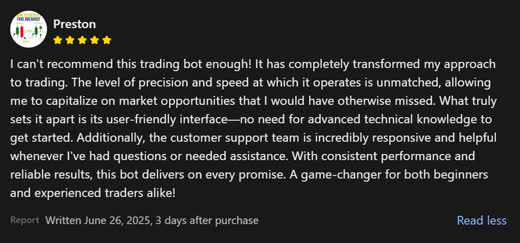
Product and service feedback. Individual experience; not a promise of financial performance.
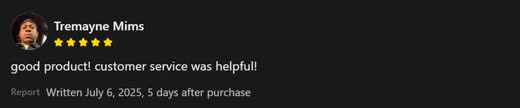
Customer-service feedback recorded after purchase.
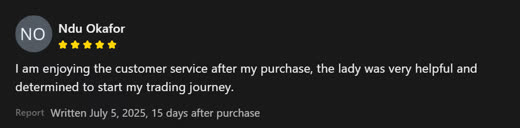
Customer-service and onboarding feedback recorded after purchase.
08 / Questions worth asking
A serious review should make room for skepticism.
Bring these questions to the call. A system should earn clarity before it earns capital.
Is the historical return a live-account result?
No. The highlighted figure is a historical backtest summary. It is not presented as a live brokerage statement, typical client outcome, or guarantee.
What happens when market conditions change?
No strategy is permanent. Configuration, session behavior, slippage, volatility, and changing market regimes must be monitored. The system can be paused when the operating assumptions no longer hold.
What is the minimum amount required?
There is no responsible one-size-fits-all answer. Account structure, contract selection, platform rules, risk tolerance, and the loss boundary must be reviewed together.
Which platforms and brokers are supported?
The ecosystem includes commonly used futures and automation platforms, but compatibility depends on the specific account, region, connection, and implementation path.
Can CodeToCashAI withdraw from my account?
The intended operating model is trade execution through a supported connection, not custody or withdrawal authority. Exact permissions must be confirmed before activation.
Who should not use an automated trading system?
Someone who requires guaranteed income, cannot tolerate drawdown, needs money for essential expenses, or does not understand the account and risk structure should not proceed.
Private system review
Bring your questions. Review the fit.
The call covers your experience, platform, account path, risk tolerance, the historical evidence, implementation, support, and whether the operating model makes sense for you.